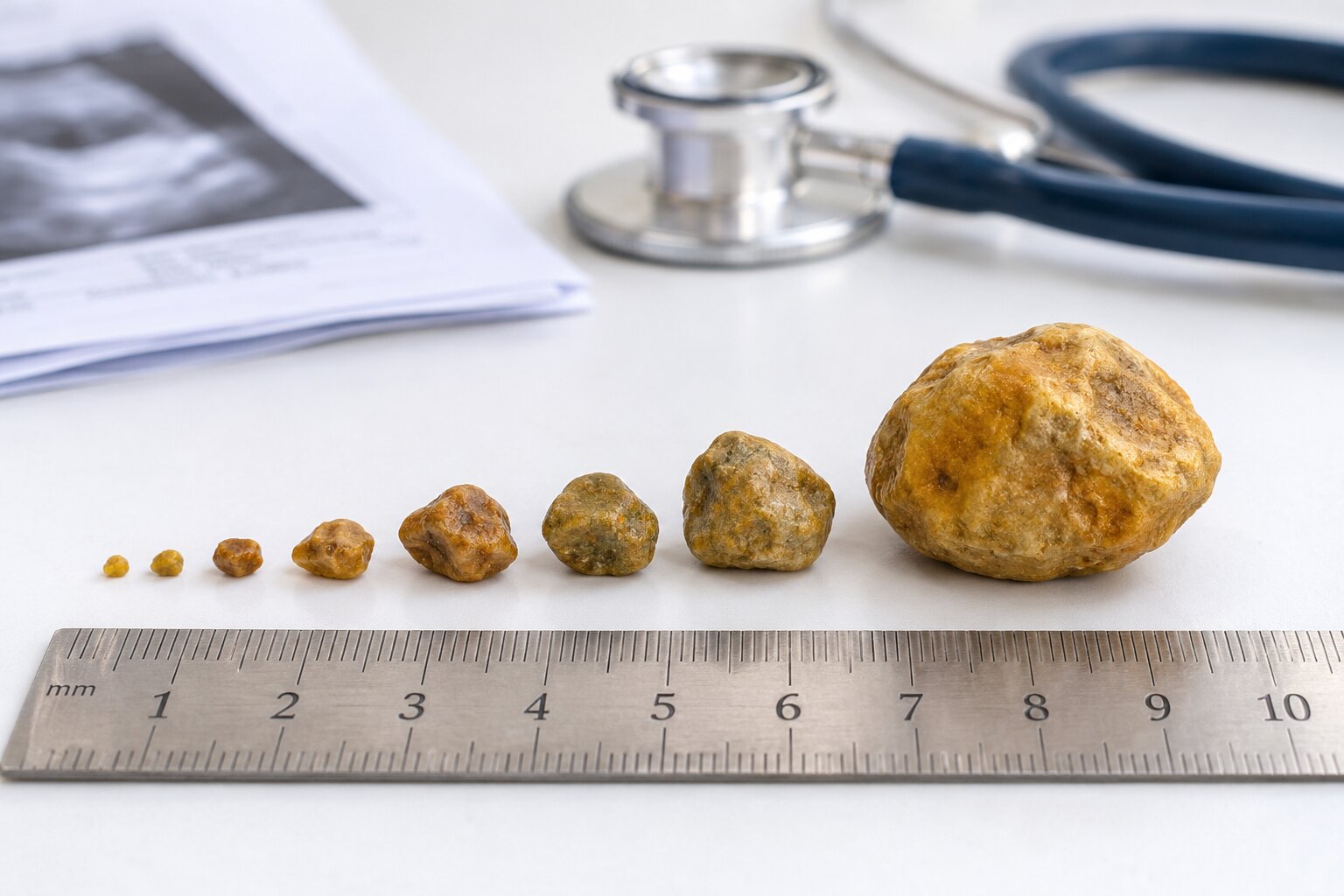
Almost every day, a patient walks into the clinic holding an ultrasound report and asks, “Doctor, my stone is only 4 mm. That is very small, so it is not dangerous, na?” Another patient says, “My stone is 2.5 cm, it is very big, I will need a big operation.”
The truth surprises most people: there is no completely “safe” size of gallbladder stone. Small stones and big stones are dangerous in different ways. In fact, some of the most serious complications, like jaundice and pancreatitis, are more common with small stones, not big ones.
In this article, we explain in simple words which size of gallbladder stone is dangerous, what each size can do, when surgery is needed, and what your ultrasound report actually means.
Quick Answer
- Small stones (less than 5 mm) are the most likely to cause jaundice and pancreatitis, because they can slip out of the gallbladder into the bile duct. Studies show people with at least one stone smaller than 5 mm have about a 4 times higher risk of gallstone pancreatitis.
- Medium stones (5 mm to 2 cm) commonly get stuck at the neck of the gallbladder and cause severe pain (biliary colic) and gallbladder infection (acute cholecystitis).
- Large stones (more than 2 to 3 cm) stay in the gallbladder but cause long-term irritation. Stones of 3 cm or more are linked to a roughly 9 to 10 times higher risk of gallbladder cancer compared with stones under 1 cm.
- If your stones cause symptoms, surgery is advised whatever the size. The standard treatment is laparoscopic gallbladder removal.
Gallstone Sizes Explained
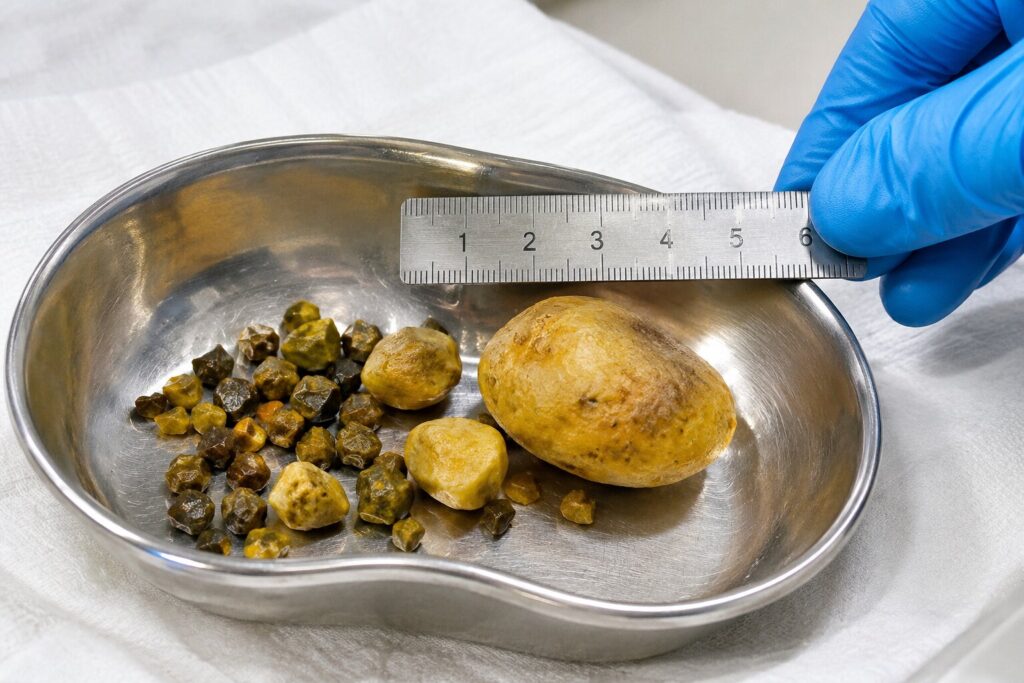
Gallstones are hard deposits that form inside the gallbladder, usually from cholesterol or bile pigments. They can be as small as a grain of sand or as big as a golf ball. Here is how doctors usually describe them:
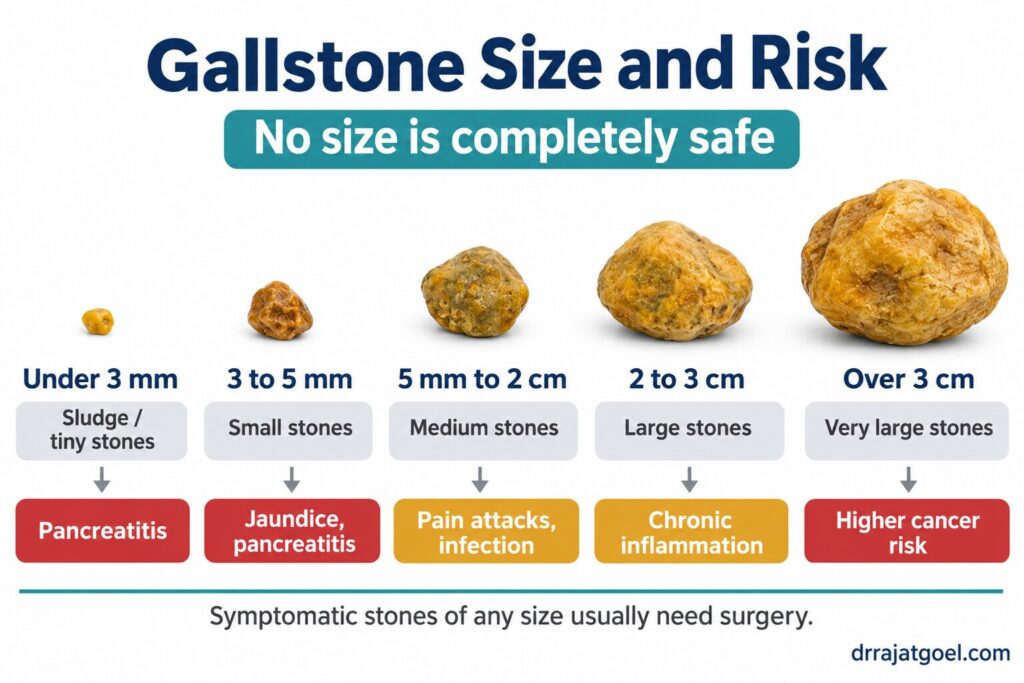
| Size on Report | What It Means | Main Risk |
| Sludge | Thick, sandy bile, not yet stones | Can cause pain, pancreatitis or form stones later |
| Less than 3 mm (microlithiasis) | Tiny stones like grains of sand | Can easily slip into the bile duct, pancreatitis |
| 3 mm to 5 mm | Small stones | Jaundice, cholangitis, pancreatitis |
| 5 mm to 2 cm | Medium stones | Pain attacks, acute cholecystitis |
| 2 cm to 3 cm | Large stones | Chronic inflammation, cholecystitis, rarely Mirizzi syndrome |
| More than 3 cm | Very large stones | Higher risk of gallbladder cancer, gallstone ileus |
Why Small Gallbladder Stones Can Be More Dangerous
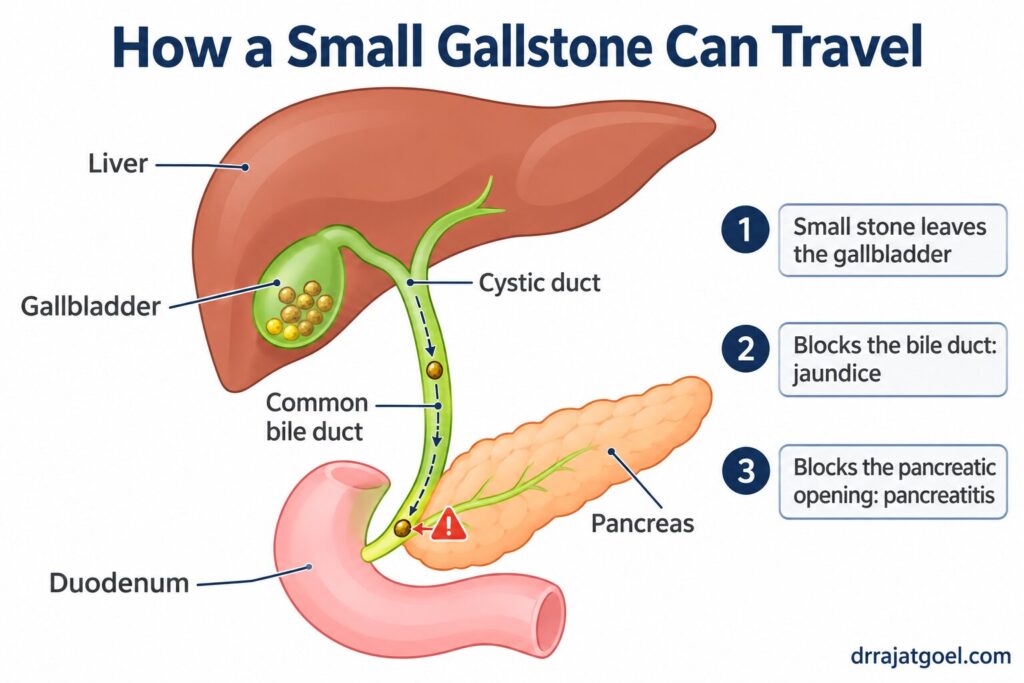
This is the part most patients do not expect. A small stone can travel. The gallbladder is connected to the main bile duct (common bile duct) through a narrow tube called the cystic duct. A stone smaller than about 5 mm can squeeze through this tube and enter the main bile duct, where it can cause three serious problems:
- Obstructive jaundice: The stone blocks the flow of bile, so eyes and skin turn yellow and urine becomes dark.
- Cholangitis: Bile behind the blockage gets infected, causing high fever with chills, jaundice and pain. This is a medical emergency.
- Gallstone pancreatitis: The stone blocks the opening shared by the bile duct and the pancreatic duct, causing severe inflammation of the pancreas. This can be life-threatening.
Research supports this clearly. In one well-known study, patients with acute pancreatitis were more likely to have at least one stone smaller than 5 mm or 20 or more stones, and having a stone under 5 mm meant about 4 times the risk of pancreatitis. Another study found that patients with jaundice, cholangitis or pancreatitis had smaller and more numerous stones than patients without these complications.
So if your report says “multiple small calculi” or “sludge”, please do not take it lightly just because the stones are small.
Why Medium-Sized Stones Cause Painful Attacks
Stones between about 5 mm and 2 cm are too big to pass easily through the cystic duct, but they can get stuck at the neck of the gallbladder. When this happens:
- You feel sudden, severe pain in the upper right or middle of the stomach, often after a heavy or oily meal, sometimes spreading to the back or right shoulder. This is called biliary colic.
- If the stone stays stuck, the gallbladder becomes swollen and infected. This is acute cholecystitis, which causes constant pain, fever and vomiting and usually needs hospital admission.
Once a person has had one attack, the chance of more attacks and complications goes up significantly.
Why Large Gallbladder Stones Are Dangerous
Big stones usually cannot leave the gallbladder, so they rarely cause jaundice or pancreatitis. But they cause different problems over time:
- Chronic inflammation: A large stone constantly rubs against the gallbladder wall, causing long-term irritation and thickening.
- Acute cholecystitis: Large stones can also block the gallbladder neck.
- Mirizzi syndrome: A big stone stuck at the gallbladder neck can press on the main bile duct and cause jaundice. This makes surgery more complex.
- Gallstone ileus: Rarely, a very large stone (usually more than 2.5 cm) erodes into the intestine and blocks it.
- Gallbladder cancer: This is the most serious concern with large stones.
Large stones and gallbladder cancer
Several studies have found a strong link between stone size and gallbladder cancer. Compared with stones smaller than 1 cm:
- Stones of 2 to 2.9 cm were linked to about 4 times the risk
- Stones of 3 cm or more were linked to about 9 to 10 times the risk
A review of the evidence concluded that patients with stones larger than 3 cm have the highest risk, and that gallbladder removal is advisable for them when their health allows (read the study). The risk also increases the longer stones stay in the gallbladder, especially over 10 to 15 years.
The overall chance of cancer is still low for most people with gallstones, so there is no need to panic. But a large stone is a strong reason to discuss surgery with your doctor.
Why This Matters More in North India
Gallbladder cancer is uncommon in Western countries, but North India, especially the Gangetic belt (Delhi, Uttar Pradesh, Bihar and nearby regions), has one of the highest rates of gallbladder cancer in the world. In parts of North India, it is among the most common cancers in women. Gallstones are present in about 80% to 90% of patients with gallbladder cancer.
Because of this, many surgeons in North India advise removing the gallbladder even in some patients without symptoms, especially if there are high-risk features like:
- Stones of 3 cm or larger
- Thickening of the gallbladder wall on ultrasound
- A gallbladder polyp of 1 cm or more
- A porcelain (calcified) gallbladder
- Stones present for many years, especially in women
This decision should always be made after a proper evaluation by an experienced surgeon.
Does the Number of Stones Matter?
Yes. Multiple small stones are more likely to cause complications than a single medium-sized stone, because there are more chances for one of them to slip into the bile duct. Studies have linked 20 or more stones with a higher risk of pancreatitis. A single large stone on the other hand carries a higher long-term inflammation and cancer risk.
Warning Signs: When to See a Doctor Immediately
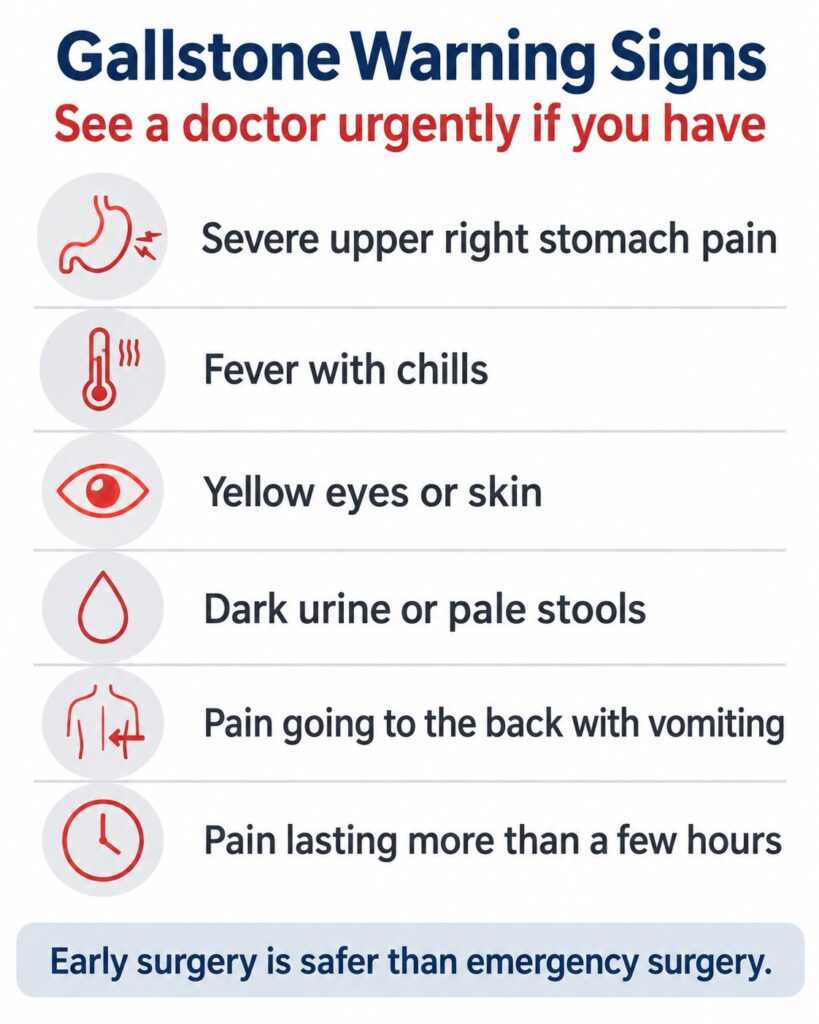
Whatever the size of your stone, go to a doctor or hospital urgently if you have:
- Severe pain in the upper right or middle of the stomach lasting more than a few hours
- Fever with chills along with stomach pain
- Yellow eyes or skin (jaundice) or very dark urine
- Pale or clay-coloured stools
- Severe pain going to the back with repeated vomiting (possible pancreatitis)
- Pain that does not settle with usual medicines
These can be signs of cholecystitis, a blocked bile duct, cholangitis or pancreatitis, all of which need prompt treatment.
Silent Gallstones: Do They Always Need Surgery?
Many people discover gallstones by chance during an ultrasound for some other reason, without any pain. These are called silent (asymptomatic) gallstones.
In general, many silent stones can be watched with regular check-ups, because a large number of people never develop symptoms. However, surgery is often advised even for silent stones if:
- The stones are 3 cm or larger
- There are many small stones or sludge (higher risk of pancreatitis)
- The gallbladder wall is thickened or there is a polyp of 1 cm or more
- The gallbladder is calcified (porcelain gallbladder)
- You live in or come from a high-risk region like North India, especially women
- You have diabetes or another condition where an infection can become severe
- You are planning pregnancy or long travel to areas with limited medical access
Can Gallbladder Stones Dissolve with Medicine?
This is one of the most common questions. A medicine called ursodeoxycholic acid (UDCA) can slowly dissolve some small cholesterol stones, but:
- It works only for small, non-calcified cholesterol stones in a gallbladder that still works properly
- It takes many months to years
- Stones often come back after the medicine is stopped
- It does not work for large stones, calcified stones or pigment stones
Home remedies like apple cider vinegar, olive oil and lemon juice “gallbladder flushes” do not dissolve gallstones. In fact, trying to “flush” small stones can push them into the bile duct and cause jaundice or pancreatitis.
Treatment: Laparoscopic Gallbladder Removal
For stones that cause symptoms, or silent stones with high-risk features, the standard and permanent treatment is laparoscopic cholecystectomy, which means removing the gallbladder through small keyhole cuts.
- It usually takes about 45 minutes to 1 hour
- Most patients go home in 1 to 2 days
- Back to normal routine in about 1 week
- You can live a completely normal life without a gallbladder. The liver continues to make bile, which flows directly into the intestine.
If a stone has already slipped into the main bile duct, it is usually removed by an endoscopic procedure called ERCP, before or after gallbladder surgery.
Removing the gallbladder early, before complications like pancreatitis or severe infection develop, makes surgery safer, simpler and quicker to recover from. Learn more about laparoscopic surgery for gallstones.
How to Read Your Ultrasound Report
Here are common phrases you may see and what they mean:
- “Cholelithiasis” or “calculi”: Gallbladder stones are present
- “Multiple calculi, largest measuring X mm”: There are many stones; note the smallest and largest size
- “Sludge” or “sludge balls”: Thick bile, which can also cause problems
- “Calculus impacted at GB neck”: A stone is stuck at the outlet, which often causes pain and infection
- “GB wall thickening”: Inflammation of the gallbladder wall, which needs evaluation
- “CBD dilated” or “CBD calculus”: The main bile duct is widened or has a stone, which needs urgent attention
- “Contracted gallbladder”: The gallbladder is shrunken, often from long-standing inflammation
Always show your full report to a surgeon rather than deciding based only on the stone size.
Frequently Asked Questions
Which size of gallbladder stone is dangerous?
No size is completely safe. Stones smaller than 5 mm are more likely to slip into the bile duct and cause jaundice or pancreatitis, while stones larger than 3 cm are linked to a higher risk of gallbladder cancer. Medium stones commonly cause pain and gallbladder infection.
Is a 5 mm gallbladder stone dangerous?
A 5 mm stone is small enough to move into the bile duct in some cases, which can cause jaundice or pancreatitis. If it causes symptoms, removal of the gallbladder is usually advised.
Is a 1 cm gallbladder stone dangerous?
A 1 cm stone usually cannot pass into the bile duct, but it can block the gallbladder neck and cause severe pain or infection. If you have symptoms, surgery is generally recommended.
Is a 2 cm or 3 cm gallstone dangerous?
Large stones can cause chronic inflammation and infection. Stones of 3 cm or more are linked to about 9 to 10 times higher risk of gallbladder cancer than stones under 1 cm, so surgery is usually advised even if there are no symptoms.
Can small gallstones pass on their own?
Some tiny stones may pass through the bile duct into the intestine, but this is exactly when they can cause jaundice, cholangitis or pancreatitis. It is not safe to wait for stones to pass.
Can gallstones be removed without removing the gallbladder?
In general, no. If only the stones are removed, new stones usually form again. Removing the gallbladder is the permanent solution. Medicines can dissolve some small cholesterol stones, but stones often come back.
Can I live normally without a gallbladder?
Yes. The liver continues to make bile, and most people live a completely normal life after gallbladder removal, with only minor diet adjustments for a few weeks.
Final Word
When it comes to gallbladder stones, size matters, but not in the way most people think. Small stones can travel and cause jaundice or pancreatitis, medium stones cause painful attacks and infection, and large stones increase the long-term risk of gallbladder cancer, especially in North India. If your stones are causing symptoms, or have high-risk features, early laparoscopic surgery is usually the safest choice.
If you have been diagnosed with gallbladder stones, you can book a consultation with Dr Rajat Goel to understand your report and the right treatment for you. Learn more about the best gallbladder surgeon in Delhi.
Disclaimer: This article is for general awareness only and is not a substitute for medical advice. Please consult a qualified surgeon for advice about your specific condition.
Medically Reviewed by Dr Rajat Goel
Dr Rajat Goel is a Laparoscopic, Bariatric and Metabolic Surgeon based in New Delhi with 23+ years of experience and 20,000+ laparoscopic surgeries, including gallbladder surgery. Read his full profile.

