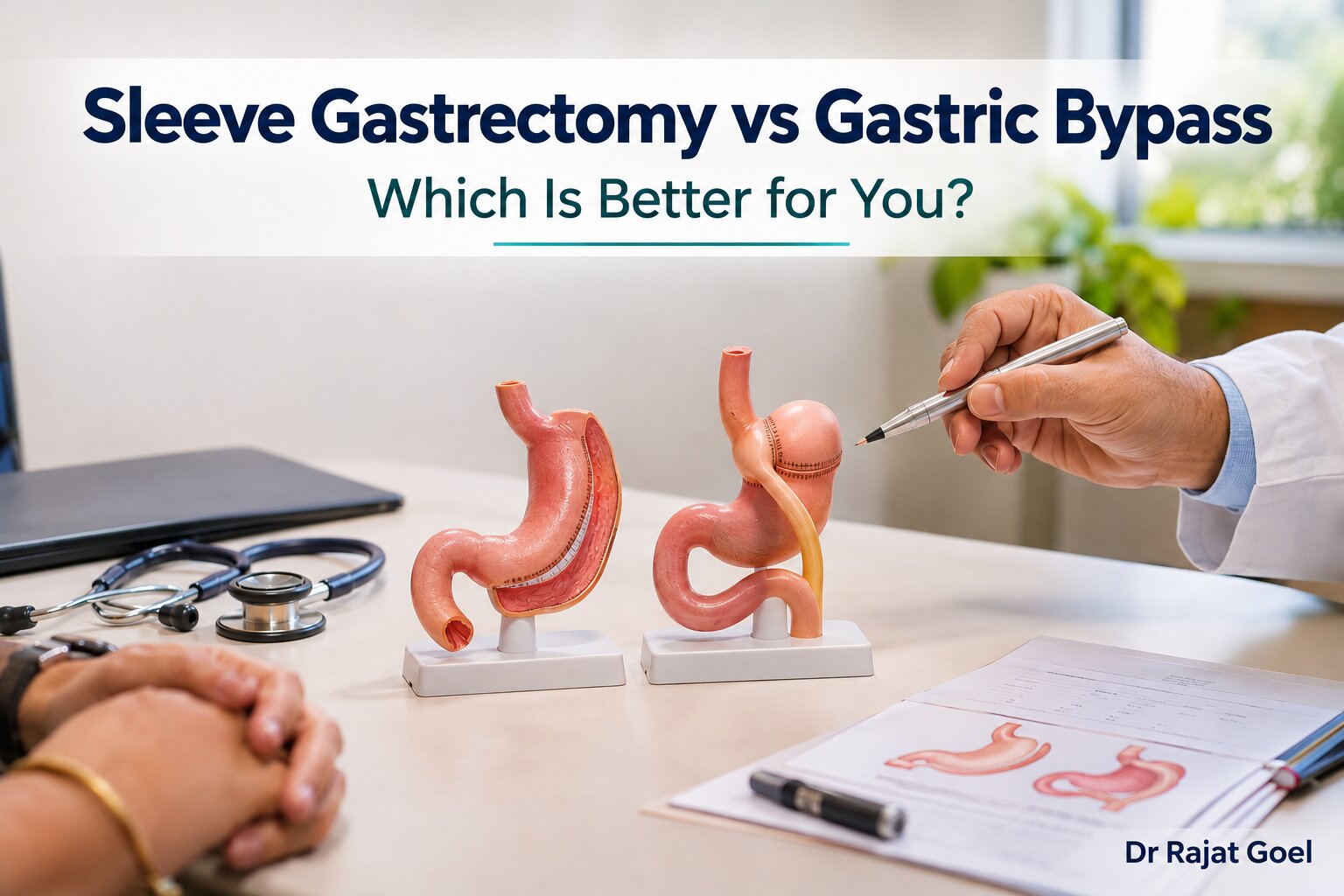
Once a patient decides to go for weight loss surgery, the next question is almost always the same: “Doctor, sleeve karwaun ya bypass? Which one is better?”
The honest answer is that both are excellent, well-proven operations, and neither is “better” for everyone. Each has its own strengths and its own trade-offs. The right choice depends on your weight, your health problems (especially diabetes and acidity), your lifestyle and your long-term goals.
In this article, we compare sleeve gastrectomy vs gastric bypass in simple words, using 10-year results from major clinical trials, so you can understand the difference and have a better discussion with your surgeon.
Quick Answer
- Both work very well. Long-term trials show both give good and lasting weight loss.
- Gastric bypass gives slightly more weight loss over 10 years and is better for acid reflux (GERD) and high blood pressure.
- Sleeve gastrectomy is simpler and quicker, keeps the normal food pathway, and has fewer long-term nutritional issues, but it can worsen or cause acidity in some patients.
- Diabetes remission is good with both, with bypass slightly ahead in most studies.
- Choose sleeve if you have no significant acidity and want a simpler operation. Choose bypass if you have GERD, hiatus hernia, severe diabetes or need maximum weight loss.
What Is Sleeve Gastrectomy?
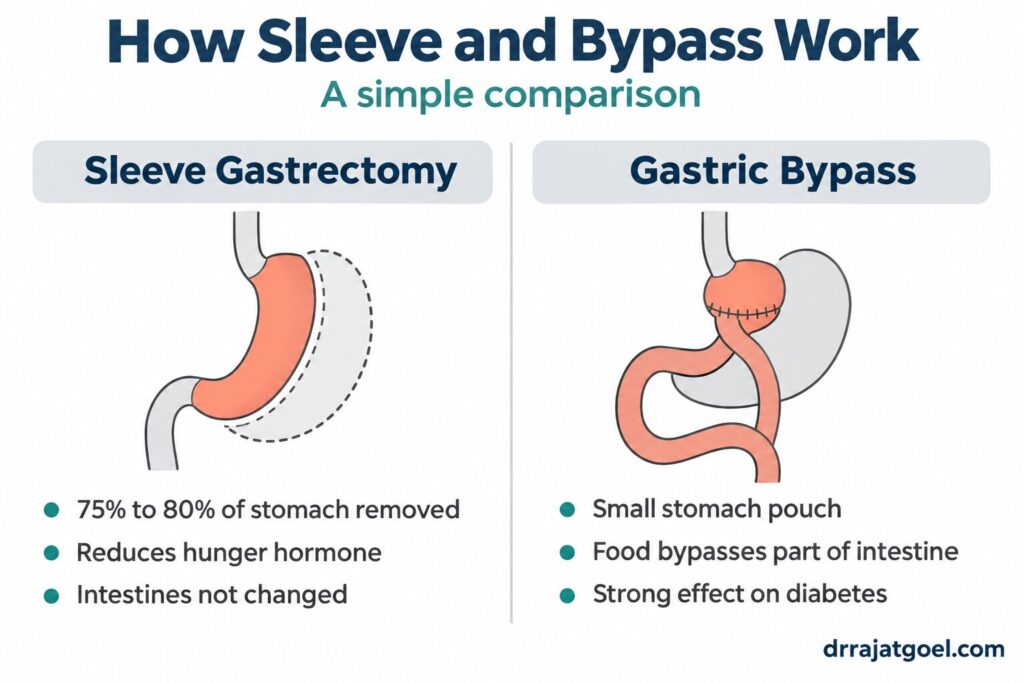
In a laparoscopic sleeve gastrectomy, the surgeon removes about 75% to 80% of the stomach through small keyhole cuts, leaving a narrow, banana-shaped tube. The intestines are not touched.
It works in two ways:
- Smaller stomach: You feel full after small meals.
- Hormonal change: The part of the stomach that makes ghrelin, the main hunger hormone, is removed, so hunger and cravings come down.
Sleeve gastrectomy is the most commonly performed bariatric surgery in India today, mainly because it is technically simpler and avoids rerouting the intestines.
What Is Gastric Bypass?
In a Roux-en-Y gastric bypass (RYGB), the surgeon creates a small stomach pouch (about the size of an egg) and connects it directly to a lower part of the small intestine. Food bypasses most of the stomach and the first part of the intestine.
It works in three ways:
- Small pouch: You eat much smaller portions.
- Less absorption: Some calories and nutrients are absorbed less.
- Strong hormonal effect: Gut hormones that control hunger and blood sugar change significantly, which is why bypass works so well for diabetes.
Gastric bypass has been performed for over 50 years and is often called the “gold standard” of bariatric surgery.
There is also a third popular option in India, the mini gastric bypass (OAGB), which we cover briefly later in this article. To understand all procedures, read our guide on the types of bariatric surgery.
Sleeve vs Bypass: Side-by-Side Comparison
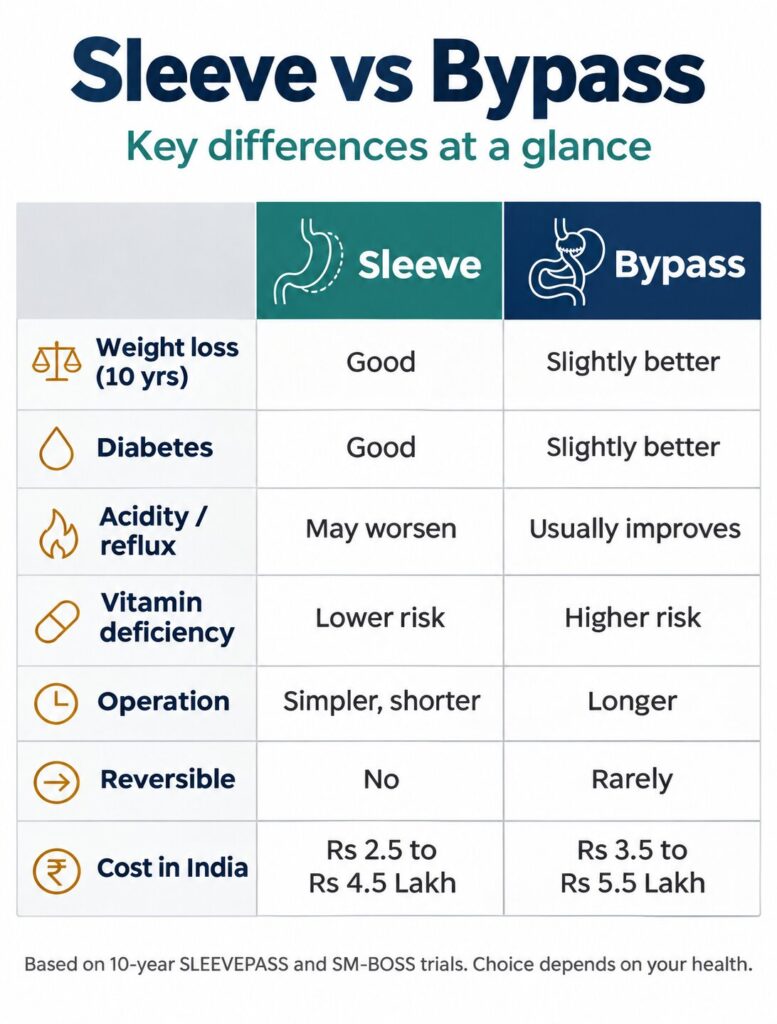
| Feature | Sleeve Gastrectomy | Gastric Bypass (RYGB) |
| How it works | Removes 75% to 80% of stomach | Small pouch plus intestinal rerouting |
| Operation time | Shorter | Longer |
| Hospital stay | 2 to 3 days | 2 to 3 days |
| Weight loss at 10 years | Good | Slightly better |
| Diabetes remission | Good | Slightly better in most studies |
| High BP remission | Good | Better |
| Acid reflux (GERD) | May worsen or start new reflux | Usually improves reflux |
| Vitamin deficiency risk | Lower | Higher, lifelong supplements essential |
| Dumping syndrome | Rare | More common |
| Painkillers (NSAIDs) | Can be used with care | Should be avoided (ulcer risk) |
| Reversible | No (stomach is removed) | Technically possible, rarely done |
| Approx. cost in India | Rs 2,50,000 to Rs 4,50,000 | Rs 3,50,000 to Rs 5,50,000 |
What Do the 10-Year Studies Say?
Two large European trials have followed patients for 10 years after sleeve or bypass, and they give us the clearest picture. The 10-year SLEEVEPASS results were published in the medical journal JAMA Surgery in 2022.
SLEEVEPASS trial (Finland, 240 patients)
- Weight loss: Median excess weight loss at 10 years was 5% after sleeve and 50.7% after bypass. Bypass was somewhat better, but both gave good and lasting results.
- Diabetes remission: About 26% with sleeve vs 33% with bypass, a difference that was not statistically significant.
- High BP remission: Clearly better with bypass (24% vs 8%).
- Reflux damage (oesophagitis): Much more common after sleeve (31% vs 7%).
- Barrett’s oesophagus: Same in both groups (4%), lower than earlier reports had suggested.
- Need for repeat surgery: Similar, about 16% after sleeve and 18.5% after bypass.
SM-BOSS trial (Switzerland, 217 patients)
- Weight loss: Excess BMI loss at 10 years was about 56% after sleeve and 66% after bypass in patients who kept their original operation.
- New reflux: Among patients with no reflux before surgery, about 32% developed reflux after sleeve, compared with about 8% after bypass.
- Conversion: Many more sleeve patients later needed conversion to another operation, mostly because of reflux or weight regain.
The researchers’ overall conclusion from both trials: both are solid operations with good long-term results, but bypass is better for reflux and gives somewhat more weight loss, while sleeve is simpler.
Which Is Better for Weight Loss?
Gastric bypass, by a small margin. Over 10 years, bypass patients lost on average about 7 to 10 percentage points more of their excess weight than sleeve patients. In practical terms, for many patients this means a few extra kilos over the long term.
But the difference is not huge, and how well you follow diet, protein intake, exercise and follow-ups after surgery often matters more than which operation you choose. A sleeve patient who follows the plan will usually do better than a bypass patient who does not.
Which Is Better for Diabetes?
Both operations can put type 2 diabetes into remission, especially if done early, before the patient needs insulin for many years. Most studies show bypass has a slight edge, particularly for:
- Long-standing diabetes (more than 5 to 10 years)
- Patients on insulin
- Uncontrolled diabetes with high HbA1c
For mild or recently diagnosed diabetes, sleeve also gives excellent results. Read more about metabolic surgery for diabetes.
Which Is Better if You Have Acidity or Reflux (GERD)?
Gastric bypass, clearly. This is the most important difference between the two operations.
- Sleeve gastrectomy turns the stomach into a narrow, high-pressure tube, which can worsen existing acidity or cause new reflux in about one in three patients over 10 years.
- Gastric bypass diverts acid away from the food pipe and is actually one of the best operations for treating reflux in people with obesity.
So if you already have frequent heartburn, regurgitation, a hiatus hernia or Barrett’s oesophagus, bypass is usually the better choice. Your surgeon may advise an endoscopy before surgery to check for this. Learn more about laparoscopic surgery for reflux (GERD).
Which Is Safer?
Both are safe operations in experienced hands, with very low complication rates at good centres. The risks are slightly different:
Sleeve gastrectomy risks:
- Leak from the staple line (uncommon)
- New or worse acid reflux
- Narrowing of the sleeve (rare)
- Weight regain over time in some patients
Gastric bypass risks:
- Vitamin and mineral deficiencies (iron, B12, calcium, vitamin D) if supplements are not taken
- Ulcers at the join, especially in smokers or those taking painkillers
- Internal hernia or intestinal blockage, sometimes years later
- Dumping syndrome (sweating, dizziness, loose motions after sweets)
In the 10-year SLEEVEPASS trial, the overall rate of repeat surgery was similar for both, about 16% to 18%.
Which Is Better for Vegetarians and Indian Diets?
This is a practical point many Indian patients ask about. After gastric bypass, the risk of iron, vitamin B12 and protein deficiency is higher, and vegetarians are already at higher risk of B12 deficiency. This does not mean vegetarians cannot have bypass, but it means lifelong supplements and regular blood tests are absolutely essential.
After sleeve, deficiencies are less common, but supplements are still needed. In both cases, getting enough protein from dal, paneer, curd, soya, eggs or protein supplements is very important to protect muscle and hair.
Who Should Choose Sleeve Gastrectomy?
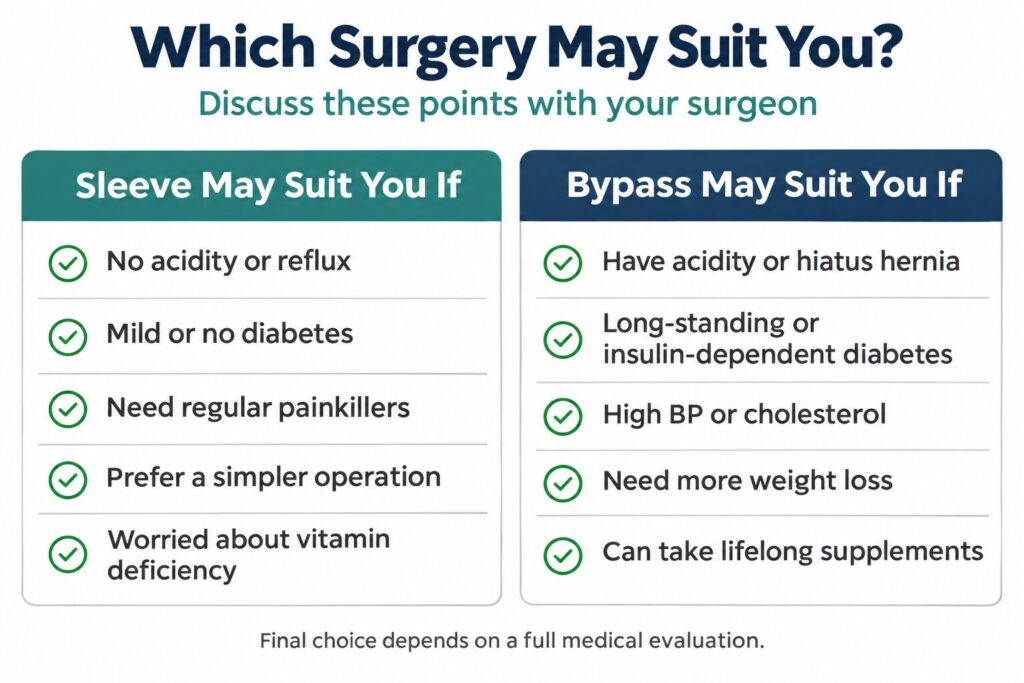
Sleeve may be a better choice if you:
- Have no significant acidity or reflux
- Have a moderate BMI and mild or no diabetes
- Need to take painkillers regularly (for arthritis, for example)
- Have bowel problems like Crohn’s disease, or had major abdominal surgery before
- Prefer a simpler operation that does not reroute the intestines
- Have a very high BMI and need a safer first-step operation (a second procedure can be done later if needed)
- Are concerned about long-term nutritional deficiencies
Who Should Choose Gastric Bypass?
Bypass may be a better choice if you:
- Have acid reflux (GERD), hiatus hernia or Barrett’s oesophagus
- Have long-standing or poorly controlled type 2 diabetes, especially on insulin
- Have high blood pressure or high cholesterol
- Need more weight loss to reach a healthy weight
- Can commit to lifelong vitamin supplements and regular blood tests
- Do not smoke and do not need regular painkillers
What About Mini Gastric Bypass (OAGB)?
The mini gastric bypass, also called one anastomosis gastric bypass (OAGB), is a popular middle option in India. It creates a long, narrow stomach tube joined to the intestine at one point.
- Weight loss and diabetes results are similar to or slightly better than standard bypass
- It is a slightly simpler operation than Roux-en-Y bypass
- It can cause bile reflux in some patients, so it may not be ideal for people with existing reflux
- Lifelong supplements are essential
It costs about Rs 3,00,000 to Rs 5,00,000 in India. Your surgeon will discuss whether it suits you.
Cost: Sleeve vs Bypass in India
| Procedure | Approx. Cost in India |
| Sleeve Gastrectomy | Rs 2,50,000 to Rs 4,50,000 |
| Mini Gastric Bypass (OAGB) | Rs 3,00,000 to Rs 5,00,000 |
| Roux-en-Y Gastric Bypass | Rs 3,50,000 to Rs 5,50,000 |
Sleeve is usually cheaper because it is a shorter operation and uses fewer staplers. Health insurance covers both when medical criteria are met. For a full breakdown, read our guide on bariatric surgery cost in India.
Can a Sleeve Be Converted to Bypass Later?
Yes. If a sleeve patient develops severe reflux or regains a lot of weight, the sleeve can be converted to a gastric bypass laparoscopically. In the SM-BOSS trial, conversion was much more common after sleeve than after bypass, mostly due to reflux. This is one reason why choosing the right operation the first time, based on a proper evaluation, is so important.
Not Ready for Surgery?
If your BMI is not high enough for surgery, or you are not ready for an operation, there are other options:
- Allurion gastric balloon, a non-surgical, swallowable balloon
- GLP-1 injections like Mounjaro and Wegovy, under medical supervision
Check your BMI with our free BMI calculator.
Frequently Asked Questions
Which is better, sleeve gastrectomy or gastric bypass?
Both are effective, well-proven operations. Gastric bypass gives slightly more weight loss over 10 years and is better for acid reflux and high BP, while sleeve gastrectomy is simpler, avoids rerouting the intestines and has fewer nutritional issues. The best choice depends on your health conditions.
Which surgery gives more weight loss?
Gastric bypass gives somewhat more weight loss in the long term. In the 10-year SLEEVEPASS trial, median excess weight loss was 50.7% after bypass and 43.5% after sleeve.
Which is better for diabetes, sleeve or bypass?
Both can put type 2 diabetes into remission. Bypass has a slight advantage, especially for long-standing diabetes or patients on insulin.
Does sleeve gastrectomy cause acidity?
It can. Sleeve gastrectomy may worsen existing reflux or cause new reflux in some patients. People with significant acidity or hiatus hernia are usually better suited for gastric bypass.
Is gastric bypass riskier than sleeve?
Both are safe in experienced hands. Bypass has a higher risk of vitamin deficiencies, ulcers and internal hernia, while sleeve has a higher risk of reflux. Overall repeat surgery rates over 10 years were similar in major trials.
Can sleeve gastrectomy be reversed?
No. In sleeve gastrectomy, part of the stomach is permanently removed. However, it can be converted to a gastric bypass later if needed.
Which is cheaper in India, sleeve or bypass?
Sleeve gastrectomy is usually cheaper, at about Rs 2,50,000 to Rs 4,50,000, compared with Rs 3,50,000 to Rs 5,50,000 for gastric bypass.
Final Word
There is no single “best” weight loss surgery. Sleeve gastrectomy and gastric bypass are both excellent operations with good long-term results, but they suit different patients. If you have significant acidity, long-standing diabetes or need maximum weight loss, bypass is often the better option. If you have no reflux and prefer a simpler operation with fewer nutritional issues, sleeve may be right for you.
The right decision comes from a detailed evaluation, including your BMI, medical history, endoscopy and lifestyle. You can book a consultation with Dr Rajat Goel to discuss which surgery suits you best. Learn more about bariatric surgery in Delhi.
Disclaimer: This article is for general awareness only and is not a substitute for medical advice. Results vary from person to person. Costs are approximate ranges in India as of November 2026.
Medically Reviewed by Dr Rajat Goel
Dr Rajat Goel is a Bariatric, Metabolic and Laparoscopic Surgeon based in New Delhi with 23+ years of experience and 2,000+ bariatric surgeries, trained in bariatric surgery in Singapore and Taiwan. Read his full profile.
Last reviewed: 10 November 2026
Follow Dr Rajat Goel: Instagram | Facebook | X (Twitter) | LinkedIn

